All Categories
🧠 Mental Health
💞 Attachment Style Quiz 😰 GAD-7 Anxiety Test 🌧️ PHQ-9 Depression Test

💞 Attachment Style Quiz — Discover Your Pattern

18 questions, 2 minutes. Identify whether you're Secure, Anxious, Avoidant, or Disorganized — and understand what drives your relationship patterns.

1 / 18

What This Quiz Measures

Comfort with closeness
How you handle emotional intimacy and vulnerability
Trust and security
Whether you feel safe depending on others
Anxiety about abandonment
Hypervigilance to partner withdrawal or rejection
Avoidance of dependence
Preference for self-reliance over emotional sharing
Fear-approach conflict
Simultaneously wanting and dreading closeness
Communication of needs
How directly you express what you need in relationships
Recovery after conflict
How quickly you return to baseline after relationship stress

The 4 Attachment Styles Explained

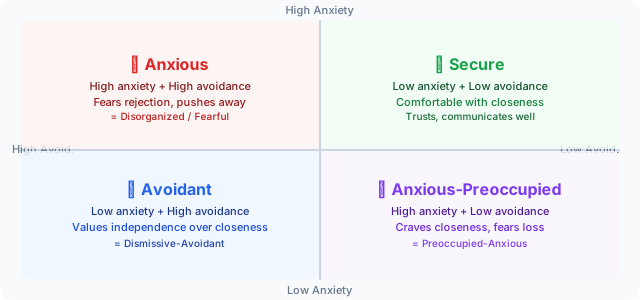
Attachment styles quadrant showing the four attachment types on anxiety and avoidance axes

Based on decades of research by Bowlby, Ainsworth, and Bartholomew.

✅ Secure

Comfortable with both closeness and independence
Trusts partners without excessive monitoring
Expresses needs clearly and without fear
Handles conflict without catastrophising
Recovers quickly from relationship setbacks

🔶 Anxious (Preoccupied)

Fears abandonment and rejection deeply
Needs frequent reassurance from partners
Hypervigilant to signals of withdrawal
May protest or pursue when partner pulls away
Often replays interactions looking for signs of trouble

🔵 Avoidant (Dismissive)

Strongly values independence and self-reliance
Uncomfortable when others get emotionally close
Tends to suppress or minimise feelings
May pull away when a relationship deepens
Often frames not needing others as a strength

🔴 Disorganized (Fearful-Avoidant)

Craves closeness but fears it at the same time
Relationships feel both necessary and threatening
Emotional states in relationships shift rapidly
May push people away when they get close
Often linked to earlier experiences with unsafe caregivers

Where Do Attachment Styles Come From?

Attachment theory was developed by British psychiatrist John Bowlby in the 1960s and 1970s. Bowlby proposed that humans are biologically predisposed to form close emotional bonds with caregivers, and that the quality of early caregiving shapes an internal working model — a mental blueprint of how trustworthy other people are and how worthy of care you are yourself.

Mary Ainsworth's "Strange Situation" experiments in the 1970s provided the first empirical evidence for distinct attachment patterns in infants. She identified three original styles: secure, anxious-ambivalent, and avoidant. A fourth category, disorganized, was added by Mary Main and Judith Solomon in 1986 to describe children whose behaviour couldn't be classified by the original three patterns — typically children who had experienced frightening or frightened caregiving.

Research on adult attachment, pioneered by Cindy Hazan and Phillip Shaver in 1987, demonstrated that the same patterns show up in romantic relationships. Kim Bartholomew and Leonard Horowitz later proposed the two-dimensional model still used today: attachment anxiety (fear of abandonment) and attachment avoidance (discomfort with closeness) — producing the four quadrants this quiz assesses.

Can Your Attachment Style Change?

Yes — and this is one of the most important findings in attachment research. Attachment styles are tendencies shaped by experience, not fixed personality traits. They can shift through three main pathways.

The first is a long-term, consistently secure relationship — romantic or otherwise — that provides enough corrective emotional experience to gradually update the internal working model. The second is therapy, particularly Emotionally Focused Therapy (EFT), schema therapy, and other attachment-informed approaches that directly target the beliefs and patterns driving insecure attachment. The third is deliberate reflective work: developing a coherent, compassionate narrative about your early experiences, which Mary Main's research shows is the single strongest predictor of earned security in adulthood.

Change typically takes time and is rarely linear — you may revert to insecure patterns under stress even as your baseline shifts. But the research is clear: adults raised with insecure attachment can and do achieve fully secure functioning.

Attachment Styles in Relationships

The most well-studied relational dynamic is the anxious-avoidant trap. The anxious partner's need for closeness triggers the avoidant partner's discomfort with it, causing withdrawal. The withdrawal confirms the anxious partner's fear of abandonment, intensifying pursuit. This cycle can continue until one or both partners understand the pattern and interrupt it consciously.

Two anxiously attached people in a relationship often experience high emotional intensity — both need reassurance and both fear abandonment — which can feel passionate but destabilising. Two avoidantly attached people may experience a relatively peaceful surface while both maintain significant emotional distance, leaving underlying intimacy needs unmet.

Disorganized attachment presents the most complexity in relationships because the approach-avoidance conflict is internal — the person simultaneously moves toward and away from closeness, often confusing both themselves and their partners. Therapy, particularly trauma-focused work, is strongly recommended.

Secure partners tend to have a regulating effect on insecurely attached partners over time. Research by Brooke Feeney and others shows that relationships with securely attached individuals are one of the most reliable pathways to earned security.

Frequently Asked Questions

The four attachment styles are: Secure (comfortable with closeness and independence, trusts partners), Anxious/Preoccupied (fears abandonment, needs reassurance, hypervigilant to partner behaviour), Avoidant/Dismissive (values independence, uncomfortable with emotional closeness, suppresses feelings), and Disorganized/Fearful-Avoidant (simultaneously craves and fears closeness, often linked to early trauma). These categories originate from Ainsworth's Strange Situation studies and Bartholomew and Horowitz's adult attachment model.

Yes. Attachment styles are not fixed traits. Research shows they can shift through corrective emotional experiences — including a stable, supportive romantic relationship, meaningful friendships, and especially therapy. Attachment-focused therapies such as Emotionally Focused Therapy (EFT) and schema therapy are particularly effective at moving people toward more secure functioning. The change is gradual but well-documented in longitudinal studies.

This quiz is based on the theoretical framework of adult attachment research by Bowlby, Ainsworth, and later Bartholomew and Horowitz. It is designed as an educational self-reflection tool, not a clinical instrument. Validated clinical measures include the Experiences in Close Relationships scale (ECR-R) and the Relationship Structures questionnaire (ECR-RS). For a thorough assessment, consult a psychologist or attachment-informed therapist.

Disorganized attachment typically develops when early caregivers are simultaneously a source of comfort and fear — for example, through abuse, neglect, or severe emotional unpredictability. The child faces an irresolvable dilemma: the person who should provide safety is the source of threat. This disrupts the normal attachment behavioural system and can result in fragmented, contradictory strategies in adult relationships. Trauma-informed therapy is the most effective intervention.

The anxious-avoidant pairing is one of the most common and challenging relationship dynamics. The anxious partner pursues closeness and reassurance; the avoidant partner withdraws when feeling overwhelmed. This creates a demand-withdrawal cycle that amplifies both people's core fears. The anxious partner's pursuit confirms to the avoidant partner that closeness is threatening; the avoidant's withdrawal confirms to the anxious partner that they will be abandoned. Both partners benefit from understanding this cycle before it escalates.

Emotionally Focused Therapy (EFT) is the most evidence-based approach for attachment-related relationship patterns. For individuals, Cognitive Behavioural Therapy (CBT) targeting reassurance-seeking behaviours, schema therapy for early maladaptive schemas (particularly abandonment and mistrust), and mindfulness-based approaches to manage hypervigilance are all effective. The goal is building what researchers call "earned security" — developing secure functioning through insight and experience despite an insecure history.

Yes. Most people have a primary attachment style with elements of others. You may be predominantly secure but show anxious patterns under high stress, or be primarily avoidant with some fearful-avoidant characteristics in very intimate relationships. Attachment also varies somewhat by relationship type — you might be more secure with friends than with romantic partners. This quiz shows all four scores to capture this nuance rather than reducing you to a single category.

Securely attached adults are comfortable with emotional intimacy without becoming enmeshed, and comfortable with independence without becoming avoidant. They communicate needs directly rather than through protest or withdrawal, trust partners without excessive surveillance, handle relationship conflict without catastrophising, and recover relatively quickly from relationship setbacks. Secure attachment is associated with higher relationship satisfaction, better emotional regulation, and stronger social support networks.

Bowlby's attachment theory proposes that early interactions with primary caregivers form an "internal working model" — a mental template of what relationships are like, how trustworthy others are, and how worthy of care you are. Consistently responsive caregiving builds secure attachment. Inconsistent responsiveness (sometimes attuned, sometimes unavailable) tends to produce anxious attachment. Consistently dismissive or emotionally unavailable caregiving produces avoidant attachment. Both sources of fear and safety together produce disorganized attachment.

Earned security refers to achieving secure attachment functioning in adulthood despite having had an insecure attachment history. It is well-documented in the research of Mary Main, who found that some adults with difficult childhoods develop coherent, secure narratives about their past through reflective insight. Therapy, stable relationships, and deliberate self-understanding are the main pathways. Earned security produces relationship outcomes nearly identical to those with continuous secure attachment from childhood.