💪 BMI Calculator — Body Mass Index for Men, Women & Teens
Enter your height and weight to instantly calculate your BMI, weight category, and healthy weight range. Supports metric and imperial units.
<18.5 Normal
18.5–24.9 Overweight
25–29.9 Obese
30+
BMI Prime (1.0 = top of healthy range)
Adjust weight loss rate
Waist-to-Hip Ratio (optional — more accurate than BMI alone)
Quick BMI Facts
Sources: WHO, CDC, NCHS
How BMI Is Calculated: The Quetelet Index Explained
BMI (Body Mass Index) was developed in 1832 by Belgian mathematician Adolphe Quetelet. The formula divides your weight in kilograms by the square of your height in metres:
In imperial units, the formula adds a conversion factor: BMI = 703 × weight (lbs) ÷ height (inches)².
BMI is a population-level screening tool. It does not directly measure body fat, and it cannot distinguish between fat mass and lean muscle mass. An athlete with significant muscle may have a "high" BMI despite low body fat. Conversely, an older adult with low muscle mass may fall in the "normal" BMI range despite excess visceral fat.
What BMI measures vs. what it misses
BMI Categories and What They Mean
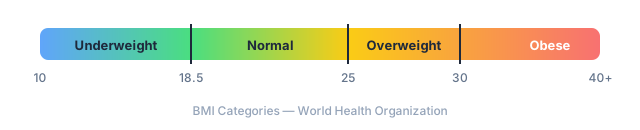
World Health Organization classification for adults aged 18 and over.
| Category | BMI Range | Health Risk | Common Causes |
|---|---|---|---|
| Underweight | < 18.5 | Moderate | Malnutrition, eating disorders, hyperthyroidism, chronic illness |
| Normal Weight | 18.5–24.9 | Minimal | Healthy diet, regular physical activity, balanced energy balance |
| Overweight | 25.0–29.9 | Increased | Excess calorie intake, sedentary lifestyle, hormonal factors |
| Obese (Class I) | 30.0–34.9 | High | Significant calorie surplus, genetic predisposition, medical conditions |
| Obese (Class II) | 35.0–39.9 | Very High | Severe calorie imbalance, limited mobility, metabolic disorders |
| Obese (Class III) | ≥ 40.0 | Extremely High | Morbid obesity — complex multifactorial causes |
Source: World Health Organization (WHO) Global Database on Body Mass Index.
Frequently Asked Questions
BMI Calculator for Women — Understanding Female Body Composition
Women's bodies are biologically designed to carry 6–11% more body fat than men of equivalent BMI, primarily to support hormonal function, fertility, and pregnancy. This means the standard BMI table — derived largely from male-dominated datasets — may slightly overestimate health risk for women with a BMI of 25–27. The American College of Obstetricians and Gynecologists recommends using BMI alongside waist circumference (goal: under 88 cm / 35 inches) for a more accurate picture.
For women approaching or past menopause, estrogen decline triggers a shift in fat distribution from the hips and thighs to the abdomen — often without any change in BMI. This makes abdominal obesity screening especially important for women over 50, even when BMI appears normal. Bone density (DEXA) scans are more accurate than BMI for assessing health status in this age group.
BMI Chart for Men by Age — How Age Affects Healthy BMI
While the WHO healthy BMI range (18.5–24.9) applies to all adult men, age significantly changes what a given BMI means in practice. Men in their 20s with a BMI of 22 typically have 15–20% body fat. A 60-year-old man with the same BMI may have 25–30% body fat due to age-related muscle loss (sarcopenia), despite appearing "normal" by the chart.
A large analysis in The Lancet found that men over 65 with BMIs of 25–27 ("overweight" by standard classification) had lower all-cause mortality than those in the 22–24.9 range, suggesting that the optimal BMI shifts upward as men age and the protective effects of modest fat reserves outweigh the metabolic risks. For men in their 60s and beyond, maintaining muscle mass through resistance training is more important than achieving a particular BMI number.
Is BMI Accurate for Athletes and Muscular People?
BMI is notoriously inaccurate for athletes. Muscle tissue is approximately 18% denser than fat tissue — meaning a highly muscular person weighs more per unit of volume than someone with equivalent fat. An NFL lineman, competitive powerlifter, or professional rugby player may have a BMI of 30–35 (classified as "obese") while carrying under 10% body fat and having excellent cardiovascular health metrics.
For athletes and regularly exercising individuals, better alternatives include DEXA body composition scans (gold standard), hydrostatic weighing, or skinfold caliper measurements. The US military uses a tape-measure-based body fat estimation rather than BMI specifically because BMI misclassifies muscular recruits. If you exercise regularly and lift weights, treat your BMI result as one data point rather than a definitive health verdict — your body fat percentage and waist circumference are far more informative.
BMI Calculator: Limitations, History, and When to Use It
The Body Mass Index was never designed as an individual diagnostic tool. Adolphe Quetelet invented it in the 1830s as a statistical measure for studying human populations — not for assessing the health of any single person. It entered clinical use in the 1970s when Ancel Keys popularised it as a convenient proxy for obesity in epidemiological research, largely because measuring actual body fat at scale was impractical.
What Your BMI Result Actually Tells You
A BMI result places you in a statistical category associated with certain average health outcomes. It does not diagnose disease, measure fitness, or predict your individual health trajectory. Two people with identical BMIs can have very different body compositions, metabolic health, and disease risk profiles. Use your BMI result as a starting point for a conversation with your doctor — not as a conclusion.
Ethnic Differences in BMI Thresholds
Research consistently shows that health risks associated with excess body fat begin at lower BMI values in South Asian, East Asian, and some other ethnic populations. The WHO has proposed adjusted cut-offs for Asian populations: overweight at BMI 23+ and obesity at BMI 27.5+. If you are of South or East Asian descent, discuss these adjusted thresholds with your healthcare provider, as the standard 25/30 cut-offs may underestimate your risk.
Disclaimer: This BMI calculator is for informational and educational purposes only. It is not a medical device and does not provide medical advice, diagnosis, or treatment. Always consult a qualified healthcare provider before making changes to your diet, exercise routine, or health management plan.