📏 Body Fat Calculator — Estimate Your Body Fat Percentage
Use the US Navy method to estimate your body fat with a tape measure. No expensive equipment needed.
Quick Body Fat Facts
Sources: ACE, US Navy, ACSM
How the US Navy Body Fat Method Works
The US Navy body fat method was developed to assess body composition without expensive lab equipment. It uses circumference measurements — waist, neck, and (for women) hips — combined with height to estimate body fat percentage.
The underlying logic: the difference between abdominal circumference and neck circumference approximates visceral fat distribution. A larger waist relative to neck indicates more fat mass. Height acts as a normalising factor.
The formula was validated against hydrostatic weighing (the gold standard) and found to estimate body fat within ±3–4 percentage points for most individuals. It's now used globally by military organisations, gyms, and fitness professionals for its practical accuracy.
Body Fat Categories (ACE)
Source: American Council on Exercise (ACE)
How to Take Accurate Measurements
Small measurement errors cause large result changes. Follow these steps for reliable readings.
Frequently Asked Questions
Body Fat Calculator for Women — Understanding Female Body Fat Ranges
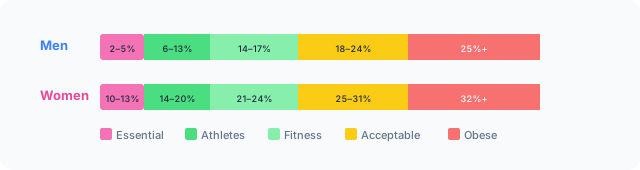
Female body fat ranges are higher than male ranges at every category because of essential fat differences driven by hormones and reproductive biology. A woman at 22% body fat is in the healthy-to-fitness range, equivalent to a man at around 12–14%. This distinction matters because many women compare themselves to male body fat standards and conclude they are overfat when they are not.
Women also distribute fat differently. Estrogen directs fat storage to subcutaneous depots around the hips, thighs, and breasts. This is called gynoid fat distribution. While more visible, this fat type is less metabolically dangerous than visceral fat. Android fat distribution (around the abdomen) is more associated with insulin resistance and cardiovascular risk — this pattern is more common after menopause when estrogen levels decline.
Body Fat Percentage for Men — What's Athletic vs Healthy?
For men, the fitness range of 14–17% body fat represents a physique with some muscle definition visible but not extreme leanness. The athletic range of 6–13% is where most serious athletes and bodybuilders operate — muscle separation is visible, and veins are apparent. Below 6% represents the essential fat threshold; bodybuilders who achieve this level for competitions experience hormonal disruption and require a rapid return to higher body fat levels.
The health risk for men increases primarily at body fat percentages above 25%, which corresponds to clinical obesity levels. However, where fat is stored matters as much as how much: a man with 22% body fat concentrated in the abdomen (high waist circumference) carries more cardiovascular risk than one with the same percentage distributed more peripherally.
How to Reduce Body Fat Percentage Without Losing Muscle
The key to reducing body fat while preserving muscle is a combination of adequate protein, resistance training, and a moderate calorie deficit. Cutting calories too aggressively (more than 700–1000 kcal/day) forces the body to break down muscle for energy. A 300–500 kcal/day deficit is the evidence-based sweet spot for fat loss with minimal muscle loss.
Protein intake during a cut should be 1.6–2.2 g/kg of bodyweight. Resistance training — at least 2–3 sessions per week — sends an anabolic signal that tells your body to maintain muscle tissue even in a deficit. Cardiovascular exercise contributes to the calorie deficit but should not replace resistance training. Many lifters find that body recomposition (losing fat while maintaining or gaining muscle) is achievable at small deficits combined with high protein and heavy training, especially for beginners and detrained individuals returning to lifting.
Body Fat Calculator: What the Number Actually Means
Body fat percentage is one of the most informative metrics in fitness assessment — but also one of the most misunderstood. The number from this calculator represents the proportion of your total body mass that is adipose tissue (fat). The remainder — muscle, bone, water, organs — is your lean mass. Both numbers matter for health, fitness performance, and appearance.
Why You Should Track Trends, Not Absolutes
No circumference-based formula is perfectly accurate for every individual. The Navy method is validated to ±3–4 percentage points against DEXA. This means a result of 18% could reasonably be anywhere from 14% to 22%. For this reason, treat your result as a baseline and focus on the direction of change over time. Consistent measurements taken under the same conditions (same time of day, same tape position) reveal trends even when the absolute value has measurement uncertainty.
Body Fat vs Body Weight on the Scale
Scale weight and body fat percentage can move in opposite directions. If you start resistance training while in a moderate calorie deficit, you may lose fat while gaining muscle — your scale weight barely changes, but your body fat percentage drops and your physique improves significantly. This is why serious body composition tracking uses both scale weight and body fat percentage together, not either metric alone.
Note: This calculator provides an estimate for general wellness guidance. It is not a medical diagnostic tool. If you have concerns about your body composition or metabolic health, consult a registered dietitian or physician.