All Categories
😴 Sleep Tools
😴 Sleep Calculator Wake-Up Calculator 💤 Nap Calculator 👶 Baby Sleep Calculator 📉 Sleep Debt Calculator Caffeine & Sleep Calculator ✈️ Jet Lag Calculator 📋 Sleep Quality Quiz

😴 Sleep Calculator — Find Your Ideal Bedtime

Find your best bedtime or wake-up time based on 90-minute sleep cycles — with a visual breakdown of your entire night.

When do you naturally wake up on free days?

Bear (most common): Your sleep follows the solar cycle. 7–8 hours with a 7–8 AM wake-up is your sweet spot.

Your Night Visualized

Awake
Light
Deep
REM
Alarm
Deep sleep
REM sleep
Cycles
Rating

Quick Sleep Facts

7–9 hrs
Recommended sleep for adults (CDC)
90 min
Average length of one sleep cycle
4–6
Cycles completed in a full night
15 min
Average time to fall asleep
23%
Adults sleeping under 7 hours nightly

Sources: CDC, NIH, AASM

How It Works

How Sleep Cycles Work: The 90-Minute Science
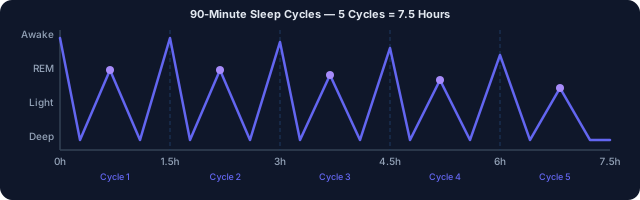
Sleep cycle diagram showing 5 complete 90-minute cycles over 7.5 hours with REM and deep sleep stages

Your brain doesn't sleep in one long block. It cycles through four distinct stages — light sleep, deeper light sleep, slow-wave deep sleep, and REM — roughly every 90 minutes all night long.

The trick is not just how long you sleep, but when you wake. Interrupting deep sleep triggers sleep inertia: that thick, cotton-headed grogginess that can persist for up to an hour. Wake during light sleep at the end of a cycle and you surface alert within seconds.

This calculator counts backward from your alarm time in 90-minute blocks, adds your personal fall-asleep delay, then draws the actual sleep architecture of your night — so you can see exactly what you're trading off between the 6-hour and 7.5-hour options.

A single 90-minute cycle

~5 min
Stage 1 — Light NREM
Drowsy, easy to wake. Muscles relax, heartbeat slows.
~20 min
Stage 2 — Light NREM
Body temperature drops, sleep spindles appear. Memory consolidation begins.
~40 min
Stage 3 — Deep NREM
Hardest to wake from. Physical repair and immune function happen here.
~25 min
REM
Dreaming. Emotional memory processing. Gets longer in later cycles.

How Much Sleep Does Your Age Group Need?

Recommendations from the AASM and CDC, based on population research.

🍼
Newborns
0–3 mo
14–17 hrs
Includes naps throughout the day and night.
👶
Infants
4–11 mo
12–16 hrs
Daytime naps gradually consolidate.
🧒
Toddlers
1–2 yrs
11–14 hrs
One long nap plus uninterrupted night sleep.
👦
Preschoolers
3–5 yrs
10–13 hrs
Afternoon naps become optional.
🎒
School Age
6–12 yrs
9–12 hrs
Consistent bedtimes improve school performance.
📱
Teenagers
13–18 yrs
8–10 hrs
Circadian shift runs later — early start times fight biology.
💼
Adults
18–64 yrs
7–9 hrs
Below 7 hrs triples cold susceptibility (Carnegie Mellon).
🧓
Seniors
65+ yrs
7–8 hrs
More wake-ups are normal; total need stays high.

Frequently Asked Questions

The calculator counts backward from your wake-up time in 90-minute blocks — the average length of one complete sleep cycle. It shows four options (3–6 cycles) so you can wake at the natural end of a cycle instead of mid-cycle, eliminating the grogginess of sleep inertia.

The CDC and AASM recommend 7–9 hours for adults aged 18–60. Teenagers need 8–10 hours; school-age children need 9–12. Consistently sleeping under 7 hours is linked to higher risk of obesity, diabetes, cardiovascular disease, and impaired cognitive function.

The hypnogram (sleep architecture chart) shows your estimated night in visual form: which stages your brain cycles through, how long you spend in deep versus REM sleep, and where your alarm falls. Deep sleep (blue) peaks in cycles 1–2; REM (purple) builds through cycles 3–6.

Your chronotype is your genetically-driven sleep-wake preference. Lions (early birds) naturally wake before 6 AM; Bears (the majority) follow the solar cycle; Wolves (night owls) run 1–2 hours later. Forcing a wolf schedule onto a lion creates chronic circadian misalignment, reducing sleep quality even at identical total hours.

Waking during deep Stage 3 sleep leaves adenosine — the brain's sleepiness chemical — still elevated. Combined with low core body temperature, this produces sleep inertia: measurably impaired reaction time, memory, and decision-making that persists 15–60 minutes. Waking at a cycle's end means adenosine has already cleared naturally.

If you wake up at 6:00 am, your ideal bedtimes are 8:30 pm (6 cycles), 10:00 pm (5 cycles), 11:30 pm (4 cycles), or 1:00 am (3 cycles). Account for roughly 15 minutes to fall asleep. The 10:00 pm bedtime is ideal for most adults — 5 complete cycles of 90 minutes each.

Sleep calculators are accurate in their cycle mathematics but approximate in their application. The 90-minute cycle length is an average — individual cycles range from 70 to 120 minutes and change across the night. The calculator is most useful as a planning guide: it reliably tells you which bedtimes are likely to result in waking between cycles rather than inside them.

The CDC recommends: infants (4–12 months) 12–16 hours, toddlers (1–2 years) 11–14 hours, preschool (3–5) 10–13 hours, school age (6–12) 9–12 hours, teenagers (13–18) 8–10 hours, adults (18–60) 7–9 hours, older adults (61+) 7–9 hours. Individual needs vary — genetics, health, and activity level all play a role.

The Real Cost of Broken Sleep Cycles

A landmark 2003 study by Van Dongen et al. at the University of Pennsylvania found that 14 consecutive nights of 6-hour sleep produced cognitive impairment equivalent to 48 hours of total sleep deprivation — yet subjects rated their own sleepiness as only "slightly impaired." They had simply lost the ability to gauge their own deficit.

A 2007 study in Sleep found that sleeping under 6 hours tripled the risk of the common cold compared to those sleeping 7+ hours, regardless of age, stress, or smoking status.

The 90-minute framework comes from Nathaniel Kleitman, who co-discovered REM sleep in 1953 and described the Basic Rest-Activity Cycle. Subsequent polysomnography research confirmed that waking at a cycle's natural end — rather than mid-cycle — dramatically reduces sleep inertia and produces better subjective sleep quality ratings.

Signs You're Waking Mid-Cycle

You feel groggy 20–30 minutes after waking even on a "full" night
You need multiple snooze alarms before feeling alert
You perform significantly better on days you wake without an alarm
Weekday vs weekend energy is dramatically different at the same total hours

Signs You're Waking at the Right Time

Alert and oriented within 2–3 minutes of waking
No urge to lie back down after turning the alarm off
Consistent energy through the morning without caffeine
You remember the content of your last dream (indicates light-sleep wake)

How to Improve Sleep Quality: 10 Evidence-Based Tips

Each one is backed by peer-reviewed research — not generic wellness advice.

🌡️
1. Keep bedroom at 65–68°F (18–20°C)
Core body temperature must drop 1–2°F to initiate sleep. A cool room accelerates this. NSF identifies room temperature as one of the top predictors of sleep quality.
📱
2. No screens 60 minutes before bed
Blue light (450–480nm) suppresses melatonin by up to 85% and delays the circadian clock by ~1.5 hours (Harvard Medical School, 2015).
3. Cut caffeine 8–10 hours before bed
Caffeine's half-life is 5–6 hours. Even when you "fall asleep fine," caffeine significantly reduces slow-wave deep sleep measured by EEG.
📅
4. Keep wake time consistent, even weekends
Social jet lag — the gap between weekday and weekend wake times — is associated with higher BMI, worse mood, and cardiovascular risk. Consistency anchors your clock.
🚶
5. Get outdoor light within 1 hour of waking
Morning light sets the circadian clock and triggers a 12–16 hour cortisol pulse that governs when you get sleepy. Cloudy outdoor light still exceeds indoor lighting 20×.
🍷
6. Avoid alcohol within 3 hours of bed
Alcohol induces sleep but fragments it. It suppresses REM in the first half of the night and causes rebound wakefulness in the second, degrading quality even if total hours are maintained.
🏃
7. Exercise — but not within 3 hours of bed
Regular aerobic exercise increases deep slow-wave sleep. Late evening exercise raises core temperature and cortisol, delaying sleep onset.
🧘
8. Use a 20–30 minute wind-down ritual
Your nervous system can't switch off instantly. A consistent pre-sleep routine signals the brain to downregulate arousal. The routine itself becomes a conditioned sleep cue.
🛏️
9. Use the bed only for sleep and sex
Stimulus control therapy (one of the most evidence-backed insomnia treatments) works by reserving the bed exclusively as a sleep cue. Working or watching TV in bed creates wakefulness associations.
10. If you can't sleep in 20 min, get up
Lying awake trains the brain that bed equals wakefulness. Get up, do something quiet in low light, return only when genuinely sleepy. This is the core of CBT-I — the gold standard insomnia treatment.

Sleep Calculator for Shift Workers

Night shift and rotating shift workers face a unique challenge: their sleep window changes constantly. Use this calculator by entering your actual wake-up target for your next shift. For rotating shifts, aim for a consistent number of cycles (5 or 6) rather than a fixed bedtime. Research from the Journal of Sleep Research shows shift workers who align sleep with 90-minute cycles report 34% fewer sleep complaints than those who simply aim for "8 hours."

Sleep Calculator for Teenagers

Teenagers need 8–10 hours of sleep per night — more than adults — because the brain undergoes significant development during adolescence. A common mistake is assuming a teen who sleeps until noon is lazy; biologically, the teenage circadian rhythm shifts later, making early school start times a genuine health issue. Use this calculator with a school wake-up time to find the ideal bedtime that completes full 90-minute cycles for a 9-hour sleep duration.

Sleep Calculator for 8 Hours of Sleep

Exactly 8 hours is a common target, but 8 hours does not divide evenly into 90-minute cycles (it gives 5.3 cycles). You are better off targeting either 7.5 hours (5 complete cycles) or 9 hours (6 complete cycles). Waking mid-cycle — even after 8 exact hours — produces the same grogginess as waking after 5 hours. This calculator automatically shows you cycle-aligned times so you never wake at the wrong stage.

Sleep Calculator: What the Research Actually Says

If you've ever woken to an alarm feeling destroyed on what should have been a full night's sleep, you've experienced the sharp difference between sleep duration and sleep timing. Total hours matter — but finishing a complete cycle matters just as much.

Why the Fall-Asleep Delay Is Often Ignored

One overlooked variable is sleep onset latency — how long it takes you to actually fall asleep after lying down. The average is 7–20 minutes for healthy adults. If you need to wake at 7:00 AM and want 7.5 hours of sleep, you might calculate an 11:30 PM bedtime. But if it takes 20 minutes to fall asleep, sleep doesn't start until 11:50 PM — short-changing you by nearly one full cycle. The calculator compensates for this directly.

The Alarm vs. No-Alarm Test

Try this on a weekend: go to bed at your calculated bedtime with no alarm set. Note your natural wake time. If it falls within 15–20 minutes of the cycle-aligned times the calculator suggests, the model is working for your physiology. Most people run close to 90-minute cycles, but some run 85 and some 100 minutes. If you consistently wake 30+ minutes before a calculated time, build your schedule around 85-minute blocks instead.

Snooze Buttons Make Things Worse

Hitting snooze doesn't help. The 7–9 minutes between alarms doesn't complete a meaningful sleep stage — it just repeatedly interrupts the body's attempt to re-enter deeper sleep without delivering any restorative benefit. You'd be better off setting the alarm 9 minutes later and sleeping straight through.

Note: This tool is for general wellness guidance. If you consistently struggle with sleep quality, experience excessive daytime sleepiness, or have symptoms like loud snoring, please consult a physician or sleep specialist. Conditions like sleep apnea and insomnia disorder require professional assessment.