🏖️ Retirement Calculator — When Can You Retire?
Enter your age, current savings, and monthly contributions to see your projected retirement nest egg, inflation-adjusted value, and whether you are on track.
PROJECTED SAVINGS GROWTH
| Year | Age | Savings (nominal) | Real value (inflation-adj.) |
|---|
Retirement Quick Facts
Sources: Trinity Study, Vanguard, Fidelity
How the 4% Rule Works: Making Your Money Last in Retirement
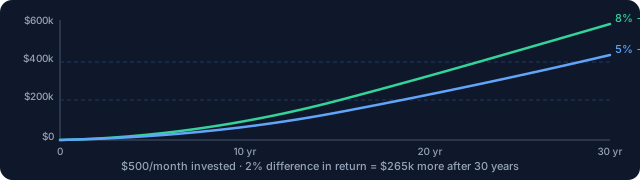
The 4% rule, originating from the 1994 Trinity Study, states that you can withdraw 4% of your retirement portfolio in year one, and adjust that amount for inflation each subsequent year, with a high probability your money will last 30+ years.
Where FV is future portfolio value, PV is current savings, r is the monthly return rate (annual ÷ 12), n is months to retirement, and PMT is your monthly contribution.
The real (inflation-adjusted) value is then: Real FV = FV ÷ (1 + inflation)^years. This tells you what your future savings are worth in today's purchasing power.
Key retirement planning concepts
Retirement Savings Target by Age and Annual Expenses
Using the 25× rule (4% withdrawal rate). These are nominal targets — real targets will be higher due to inflation.
| Annual Expenses | Target (25×) | Monthly Income (4%) | Save $1k/mo from 25 (7% return) | On Track? |
|---|---|---|---|---|
| $30,000 | $750,000 | $2,500 | ~Age 57 | ✅ Achievable |
| $40,000 | $1,000,000 | $3,333 | ~Age 63 | ✅ Common target |
| $50,000 | $1,250,000 | $4,167 | ~Age 66 | ⚠️ Stretch goal |
| $60,000 | $1,500,000 | $5,000 | ~Age 69 | ⚠️ Need higher contributions |
| $80,000 | $2,000,000 | $6,667 | ~Age 74 | ❌ Requires aggressive saving |
| $100,000 | $2,500,000 | $8,333 | ~Age 79 | ❌ High income or FIRE strategy needed |
Assumes 7% annual return on $1,000/month contribution starting at age 25, no existing savings. For illustration only.
Frequently Asked Questions
Retirement Calculator UK — How Much Do I Need in a UK Pension?
In the United Kingdom, retirement planning involves a combination of the State Pension, workplace pensions (now auto-enrolled under the Pensions Act 2008), and personal savings. The full new State Pension (2024/25) is £11,502 per year, received from State Pension age (currently 66, rising to 67 by 2028).
The Pensions and Lifetime Savings Association (PLSA) publishes "Retirement Living Standards" benchmarks for the UK. As of 2024, their figures are: Minimum standard (covering basic needs) requires approximately £14,400/year for a single person; Moderate standard (some financial security and flexibility) requires £31,300/year; and a Comfortable standard (more financial freedom and luxuries) requires £43,100/year.
For a comfortable retirement at £43,100/year and a State Pension covering £11,502, you need your private pension and savings to provide approximately £31,600/year. Applying the 25× rule: £31,600 × 25 = £790,000 in your pension pot. The Lifetime Allowance was abolished in April 2024, removing the previous £1.073m cap on tax-advantaged pension savings.
Workplace pensions in the UK benefit from tax relief (basic rate taxpayers effectively contribute £80 for £100 pension input), employer contributions (minimum 3% of qualifying earnings), and the compounding of investments over decades. Use our calculator above — select £ as currency — to model your UK retirement savings trajectory.
Early Retirement Calculator — FIRE (Financial Independence, Retire Early)
The FIRE movement is built on two core mathematical relationships: your savings rate determines how quickly you accumulate wealth, and your withdrawal rate determines how long your wealth lasts.
The key insight from the FIRE community is that saving rate is a function of both income and spending. Cutting expenses is often more powerful than increasing income, because a lower expense level also reduces your retirement target (since your required savings is 25× your annual expenses). Someone spending $30,000/year needs only $750,000 to retire; someone spending $80,000/year needs $2 million.
Approximate years to FIRE by savings rate (assuming 5% real return, starting from zero):
- 10% savings rate: ~43 years to financial independence
- 25% savings rate: ~32 years
- 50% savings rate: ~17 years
- 65% savings rate: ~11 years
- 75% savings rate: ~8 years
These figures demonstrate why lifestyle frugality accelerates FIRE so dramatically — a high savings rate compresses the accumulation timeline while simultaneously lowering the finish line. Many FIRE practitioners use low-cost total market index funds (Vanguard, iShares) as their primary investment vehicle, minimising fees that would otherwise erode long-term returns.
For early retirement lasting 40+ years, many FIRE practitioners prefer a 3–3.5% withdrawal rate rather than the full 4%, providing a larger margin of safety against sequence-of-returns risk and unforeseen expenses.
How Much Should I Save Each Month to Retire at 60?
Retiring at 60 instead of 65 creates two compounding challenges: five fewer years of contributions and compound growth during accumulation, and five more years of withdrawals during retirement. Together these can require a significantly larger nest egg and/or a higher monthly savings rate.
Let's model a specific example. Goal: retire at 60 with $1.5 million (covering $60,000/year at a 4% withdrawal rate). Starting at age 30 with $10,000 saved, 7% annual return:
- To reach $1.5M in 30 years at 7% return: approximately $1,200/month
- If you start at age 40 (only 20 years): approximately $3,100/month
- If you start at age 45 (only 15 years): approximately $5,200/month
These numbers illustrate why starting early is so powerful. Each decade of delay roughly doubles or triples the required monthly contribution. Additionally, retiring at 60 in the US means 5 years without Medicare eligibility (available at 65), making private health insurance a significant budget item — often $500–$1,500+/month for a family — that must be factored into both your accumulation target and withdrawal planning.
The most reliable path to age-60 retirement is: maximising tax-advantaged accounts (401k, IRA, or UK SIPP/ISA) from as early as possible, investing in low-cost diversified index funds, keeping lifestyle inflation in check as income grows, and considering a flexible "Coast FIRE" approach where you stop contributions once the portfolio is large enough to grow to your target by retirement age without further input.
About This Retirement Calculator
MindSnap's retirement calculator uses the standard compound interest future value formula to project your retirement savings. It accounts for both the growth of existing savings (present value) and the accumulation of regular monthly contributions (ordinary annuity), compounded monthly at your specified annual return rate.
Inflation adjustment uses simple purchasing power deflation: the nominal future value is divided by (1 + inflation rate)^years to produce the real value in today's dollars. The 4% rule and 25× savings target are used as retirement readiness benchmarks. The decade-by-decade growth table allows you to see the trajectory of your savings and identify the years when compound growth begins to accelerate most dramatically.
Important disclaimer: This calculator is for educational and planning purposes only. It does not constitute financial advice. Investment returns are not guaranteed — markets fluctuate, and past performance does not predict future results. Please consult a qualified financial adviser or certified financial planner (CFP) for personalised retirement planning guidance.