🐶 Dog Age Calculator — Human Years by Breed Size
Find out how old your dog really is in human years. Our formula adjusts for breed size — because a 10-year-old Chihuahua and a 10-year-old Great Dane are very different ages.
Dog Age Facts
Why Don't All Dogs Age the Same?
The familiar "multiply by 7" shortcut has been repeated for decades, but it was never based on biology — it was a rough marketing device. Modern veterinary science paints a far more nuanced picture.
Dogs age non-linearly and at radically different rates depending on body size. In the first two years of life, all dogs — regardless of breed — go through an intense developmental sprint. By the end of year one, a puppy has matured through the human equivalent of childhood, puberty, and adolescence all at once, reaching a human-equivalent age of roughly 15. By year two, they've added another 9 human years, reaching the equivalent of a 24-year-old adult.
After year two, breed size becomes the dominant factor. A small dog (under 20 lbs) adds roughly 4 human years per dog year. A medium dog adds 5 human years per year. A large dog adds 7 human years per year — meaning a 10-year-old Great Dane is already in geriatric territory, while a 10-year-old Chihuahua is still in its senior but active years.
The underlying cause is accelerated cellular aging in larger bodies. Research published in The American Naturalist found that each additional 4.4 lbs of body weight in dogs reduces life expectancy by approximately one month — a consistent, size-dependent gradient not seen in most other species.
Signs Your Dog Is Aging
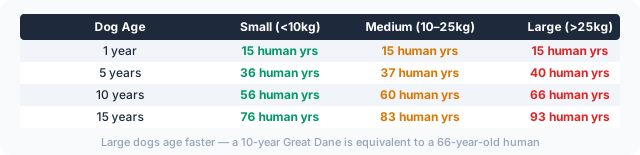
Dog Years vs Human Years — Full Comparison Table
Based on the science-based formula: Year 1 = 15, Year 2 = +9, then +4/+5/+7 per year by size.
| Dog Age | Small (<20 lbs) | Medium (20–50 lbs) | Large (>50 lbs) | Life Stage |
|---|---|---|---|---|
| 1 year | 15 | 15 | 15 | Puppy |
| 2 years | 24 | 24 | 24 | Junior |
| 3 years | 28 | 29 | 31 | Junior |
| 4 years | 32 | 34 | 38 | Adult |
| 5 years | 36 | 39 | 45 | Adult |
| 6 years | 40 | 44 | 52 | Adult |
| 7 years | 44 | 49 | 59 | Mature |
| 8 years | 48 | 54 | 66 | Mature |
| 9 years | 52 | 59 | 73 | Mature |
| 10 years | 56 | 64 | 80 | Senior |
| 11 years | 60 | 69 | 87 | Senior |
| 12 years | 64 | 74 | 94 | Senior |
| 13 years | 68 | 79 | 101 | Geriatric |
| 14 years | 72 | 84 | 108 | Geriatric |
| 15 years | 76 | 89 | 115 | Geriatric |
Formula: Year 1 = 15 human yrs; Year 2 = +9; Small +4/yr, Medium +5/yr, Large +7/yr thereafter.
Frequently Asked Questions
How to Keep Your Dog Healthy at Every Life Stage
Understanding your dog's true age in human years isn't just a curiosity — it's a practical tool for better care. A dog at the human equivalent of 50 has very different nutritional, exercise, and medical needs than one at the human equivalent of 25.
Puppy & Junior (0–3 dog years)
The first three years are a period of explosive development. Puppies require calorie-dense food formulated for growth, a full vaccination schedule, early socialisation with people and other dogs, and positive reinforcement training. The first 12–16 weeks are the critical socialisation window — experiences during this time shape behaviour for life. Large-breed puppies should not be over-exercised before growth plates close (typically 12–18 months) to avoid joint damage.
Adult (3–7 dog years)
Adult dogs need consistent exercise — most medium and large breeds require 45–90 minutes of activity per day. Annual vet check-ups are appropriate at this stage. Dental disease affects 80% of dogs by age 3, so daily teeth brushing or dental chews are important. Maintain a lean body condition — every pound of excess weight on a small dog is proportionally equivalent to 10+ lbs on a human.
Mature & Senior (7–12 dog years)
From the mature stage onward, bi-annual vet visits are recommended for large breeds. Blood and urine panels can detect kidney disease, hypothyroidism, and diabetes before symptoms appear. Switch to a senior-formulated food appropriate to your dog's size. Low-impact exercise like swimming and short, frequent walks is better than long runs that stress ageing joints.
Geriatric (12+ dog years)
Geriatric dogs may need prescription diets for kidney or heart support, pain management for arthritis, and environmental modifications such as ramps and orthopedic beds. Cognitive dysfunction syndrome is common — mental stimulation through sniff work, puzzle feeders, and gentle training sessions can slow decline. Quality of life discussions with your vet are appropriate at this stage.