All Categories
😴 Sleep Tools
😴 Sleep Calculator Wake-Up Calculator 💤 Nap Calculator 👶 Baby Sleep Calculator 📉 Sleep Debt Calculator Caffeine & Sleep Calculator ✈️ Jet Lag Calculator 📋 Sleep Quality Quiz

👶 Baby Sleep Calculator — Nap Schedule by Age

Enter your baby's age and first wake-up time to get a personalised nap schedule, bedtime, and total sleep target.

Baby Sleep at a Glance

14–17h
Total sleep needed: Newborns
12–15h
Total sleep needed: 4–11 months
11–14h
Total sleep needed: 1–2 years
45–60m
Max wake window: Newborns
3–4h
Max wake window: 12 months

Sources: AASM, AAP, NHS

Sleep Needs by Age
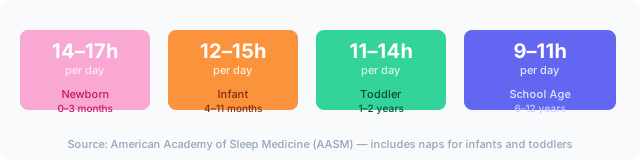
Baby sleep needs chart showing recommended sleep hours by age from newborn to toddler

Recommendations from the American Academy of Sleep Medicine and AAP.

Age Total Sleep Night Sleep Naps Wake Window
Newborn (0–3 mo) 14–17h 8–9h 3–5 naps 45–60 min
3–4 months 14–16h 9–10h 3–4 naps 60–90 min
4–6 months 12–15h 10–11h 3 naps 1.5–2.5h
6–8 months 12–15h 10–11h 2–3 naps 2–3h
8–10 months 12–15h 10–11h 2 naps 2.5–3.5h
10–12 months 12–15h 10–11h 2 naps 3–4h
12–18 months 11–14h 10–11h 1–2 naps 3–4h
18–24 months 11–14h 11h 1 nap 4–6h
2–3 years 11–14h 10–11h 1 nap (optional) 5–6h
🛡️

Safe Sleep Checklist (AAP Guidelines)

Following safe sleep practices significantly reduces the risk of SIDS (Sudden Infant Death Syndrome) and sleep-related infant deaths. The AAP recommends:

✓ Always place baby on their BACK
For every sleep — naps and nighttime. The back sleep position is the safest until the baby can roll both ways independently.
✓ Firm, flat sleep surface
Use a safety-approved crib, bassinet, or play yard mattress. No soft mattresses, sofas, armchairs, or adult beds.
✓ Room-share, don't bed-share
Baby in your room on a separate surface for at least 6 months. This halves SIDS risk while keeping night feeds manageable.
✓ Keep sleep space bare
No pillows, blankets, bumpers, positioners, or toys in the sleep area. Use a sleep sack instead of blankets.
✓ Avoid overheating
Keep room at 68–72°F (20–22°C). Dress baby in one more layer than you're comfortable in. No hats indoors during sleep.
✓ Offer a dummy/pacifier at sleep time
After breastfeeding is established (3–4 weeks). Pacifier use at sleep onset is associated with reduced SIDS risk.

Source: American Academy of Pediatrics Safe Sleep Guidelines (2022). Always consult your paediatrician for personalised advice.

Frequently Asked Questions

A wake window is the maximum time a baby can comfortably stay awake between sleeps. Exceeding the wake window causes overtiredness — a paradoxical state where elevated cortisol makes it harder for the baby to fall asleep and stay asleep. Watching wake windows is one of the most effective tools for reducing infant sleep problems.

Babies begin developing a circadian rhythm between 3–6 months as melatonin production matures. Before this, they have no meaningful internal clock — which is why newborn sleep is distributed evenly around the clock rather than concentrated at night. Exposure to natural light during the day and darkness at night from birth helps the rhythm develop faster.

Yes. Infant sleep is biologically different from adult sleep. Babies spend proportionally more time in lighter REM sleep and have shorter sleep cycles (45–50 minutes vs. 90 minutes in adults). Night waking is normal and expected through at least the first year. Frequent waking after 6 months can sometimes be addressed with sleep training approaches, but consult your paediatrician first.

The AAP recommends placing babies on their back on a firm, flat surface for every sleep, in the parents' room but on a separate sleep surface for at least the first 6 months. No soft bedding, pillows, bumpers, or toys in the sleep space. Room sharing (not bed sharing) reduces SIDS risk by up to 50%.

Signs of overtiredness include: difficulty falling asleep despite showing sleep cues, arching back, increased fussiness after sleep cues appear, rubbing eyes vigorously, pulling ears, yawning, losing interest in activity, and sudden crying episodes. Acting on early sleep cues (yawning, eye rubbing, glazed look) before overtiredness sets in makes settling much easier.

The AAP recommends room-sharing (baby in their own sleep surface in your room) for at least the first 6 months — this reduces SIDS risk by up to 50%. Bed-sharing (same sleep surface) is not recommended due to suffocation and SIDS risk, especially under 4 months. If you choose to bedshare, follow safe bedsharing guidelines: firm mattress, no alcohol or sedatives, no soft bedding near the baby.

Most babies can manage 6–8 hour stretches by 4–6 months when they have sufficient weight and are feeding well. Full 8–12 hour nights are typical from 6–9 months, though every baby is different. Before 4 months, night feeds are biologically necessary — not a habit to be broken. After 6 months, if frequent waking continues, gentle sleep training approaches can be discussed with your paediatrician.

Most 6-month-olds take 2–3 naps per day totalling 3–4 hours, with nighttime sleep of around 10–11 hours. By 6–8 months, many babies consolidate from 3 naps to 2. Signs your baby is ready to drop a nap: taking longer than 20 minutes to fall asleep at nap time, or nighttime sleep is reducing without reason.

Most babies sleep a 6–8 hour stretch by 4–6 months, though "sleeping through the night" is typically defined as 5+ uninterrupted hours. By 9 months, roughly 70–80% of babies sleep 8+ hours without waking. However, there is enormous individual variation — some babies sleep through at 3 months, others not until 18 months, both within the normal range.

No — the AAP recommends babies always be placed on their back to sleep until 12 months. Back sleeping reduces the risk of SIDS (Sudden Infant Death Syndrome) by over 50%. Once a baby can roll from back to front and front to back independently (typically 4–6 months), it is safe to leave them in whatever position they roll to during sleep. Always start them on their back.

Newborn Sleep Schedule — 0 to 3 Months

Newborns (0–3 months) sleep 14–17 hours per day in short bursts of 2–4 hours because their circadian rhythm has not yet developed. There is no "schedule" at this stage — newborns are driven entirely by hunger and comfort. Parents should sleep when the baby sleeps. By 6–8 weeks, most babies begin showing a slightly longer nighttime stretch of 4–5 hours, which is the first sign of circadian development.

Baby Sleep Regression — What It Is and When It Happens

Sleep regressions are temporary periods when a previously good sleeper starts waking more frequently. The most common regressions occur at 4 months, 8–10 months, 12 months, 18 months, and 2 years — all coinciding with major developmental leaps. The 4-month regression is the most significant because it represents a permanent change in sleep architecture (babies shift to adult-like sleep cycles). Most regressions last 2–6 weeks and resolve on their own.

How to Get a Baby to Sleep Through the Night

Most babies are developmentally capable of sleeping 6–8 hours without feeding by 4–6 months, though individual variation is wide. Key strategies supported by paediatric sleep research: establish a consistent pre-sleep routine (bath, feed, dark room), put baby down drowsy but awake to build self-soothing skills, keep night interactions brief and low-stimulation, and ensure total daytime sleep is age-appropriate (too much daytime sleep reduces nighttime sleep pressure).