✈️ Jet Lag Calculator — Personalised Sleep Recovery Plan
Enter your flight details and get a personalised jet lag recovery plan with target sleep times for your destination.
Jet Lag Facts
Evidence-Based Jet Lag Recovery Tips
What the research says — not just general travel advice.
How to Use Melatonin for Jet Lag
Melatonin is the most evidence-backed pharmacological intervention for jet lag. A Cochrane review of 10 randomised trials (Herxheimer & Petrie, 2002) concluded it is remarkably effective at reducing jet lag symptoms, particularly for eastward travel of 5 or more time zones.
The key insight is timing over dose. Taking melatonin at the wrong time can worsen jet lag rather than help it. The circadian clock is a phase-response system — melatonin in the afternoon delays your clock; melatonin in the morning advances it. Only evening use (at destination bedtime) is appropriate for jet lag recovery.
Use the lowest effective dose. Most commercial melatonin tablets are 5–10mg — 5 to 20 times higher than what research shows is effective (0.5mg). Higher doses increase next-day grogginess and suppress endogenous melatonin production over time.
Melatonin Protocol by Travel Direction
- Take 0.5–3mg melatonin at destination bedtime (9–11 PM)
- Continue for 3–4 nights after arrival
- Combine with morning light exposure at destination
- Avoid evening bright light (especially screens) at destination
- Melatonin less critical — natural delay is easier
- If using: 0.5mg at destination bedtime for 2–3 nights
- Get bright light in the late afternoon at destination
- Stay awake as long as possible on arrival day
Frequently Asked Questions
Jet Lag Recovery — Eastward vs Westward Flights
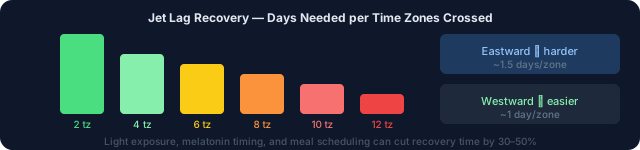
Eastward travel is consistently harder to recover from than westward travel. Flying east requires advancing your circadian clock (going to sleep earlier than your body wants), which conflicts with the natural human tendency toward a slightly longer-than-24-hour internal day. Flying west requires delaying your clock (staying up later), which is more natural. As a rough guide: westward recovery takes 1 day per time zone crossed; eastward recovery takes 1.5 days per time zone. A 6-hour eastward flight can take 9 days to fully recover from.
How Long Does Jet Lag Last?
Jet lag duration depends on the number of time zones crossed and direction of travel. For short hauls (1–3 time zones), most people adjust within 1–3 days. For long hauls (6–12 time zones), full adjustment typically takes 6–12 days. Athletes and frequent travellers often adapt faster due to practiced sleep routines. Age also matters: older adults typically experience more severe jet lag and take longer to adjust than younger adults.
Jet Lag Tips for Long-Haul Flights
Evidence-based strategies to minimise jet lag: (1) Pre-adjust — shift your sleep 1 hour per day toward your destination time zone for 3 days before departure. (2) Light exposure — get bright light in the morning at your destination for eastward travel; bright light in the evening for westward. (3) Melatonin — 0.5 mg taken at the target destination's bedtime helps re-anchor your circadian clock. (4) Hydration — cabin air is extremely dry; dehydration worsens jet lag symptoms significantly. (5) Avoid alcohol on the flight — it fragments sleep quality even when you feel like it helps you sleep.