All Categories
😴 Sleep Tools
😴 Sleep Calculator Wake-Up Calculator 💤 Nap Calculator 👶 Baby Sleep Calculator 📉 Sleep Debt Calculator Caffeine & Sleep Calculator ✈️ Jet Lag Calculator 📋 Sleep Quality Quiz

📉 Sleep Debt Calculator — How Much Sleep Are You Missing?

Enter how much sleep you're actually getting versus what you need. See your debt in hours and get a recovery plan.

8h

Sleep Debt Impact

Higher cold risk after <7 hrs/night (Carnegie Mellon)
48h
Equivalent impairment from 2 weeks of 6h sleep
13%
Lower reaction time per night of 6h vs 8h sleep
4 nts
Recovery time needed after short-term sleep debt
23%
Adults sleeping under 7 hours per night (CDC)

Sources: CMU, UPenn, CDC, NIH

The Real Cost of Sleep Debt

Research-backed effects of cumulative sleep deprivation at different debt levels.

0–2 hrs
Mild Deficit

Slightly reduced attention and reaction time. Most people don't notice. Manageable with one recovery night.

2–5 hrs
Moderate Deficit

Measurable decline in memory, mood, and decision-making. 2–3× higher risk of microsleeps while driving. Feels like normal tiredness.

5–10 hrs
Significant Deficit

Equivalent to mild alcohol intoxication. Reaction time, working memory, and creativity are all impaired — but subjects rate themselves as only "slightly sleepy." Requires 3–5 recovery nights.

10+ hrs
Severe Deficit

Equivalent to 48h of total sleep deprivation. Immune function suppressed, metabolic markers disrupted, emotional regulation breaks down. Requires 1–2 weeks of recovery sleep.

The Research

Why Sleep Debt Feels "Fine" Until It's Not
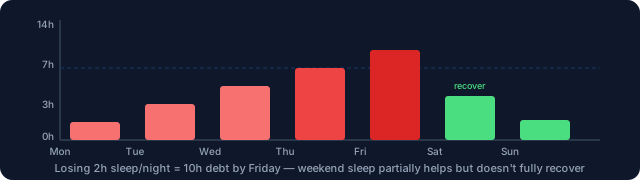
Sleep debt accumulation chart showing how missed sleep adds up over a week

The most dangerous aspect of sleep debt isn't the impairment itself — it's that the brain loses its ability to accurately gauge that impairment. A landmark 2003 study by Van Dongen and colleagues at the University of Pennsylvania had participants sleep 6 or 4 hours per night for 14 consecutive nights.

By day 14, the 6-hour group showed cognitive performance equivalent to someone who had been awake for 48 straight hours. Yet subjective sleepiness ratings plateaued around day 5 — participants thought they had adapted. They hadn't. They had simply lost the neurological sensitivity to detect their own deficit.

This is the core problem with modern sleep culture: we benchmark our performance against our impaired baseline, not against our rested potential. The productivity gains from recovering sleep debt are often invisible because people cannot remember what "fully rested" feels like.

Cumulative Effect of 6h Sleep Over 2 Weeks

Days 1–3 Slightly impaired attention and reaction time. Most people don't notice.
Days 4–7 Measurable decline in memory, decision-making, and emotional regulation.
Days 8–11 Equivalent to missing 1 full night of sleep. Significant cognitive deficit.
Days 12–14 Equivalent to 48h sleep deprivation. Brain cannot self-assess impairment.

Source: Van Dongen et al. (2003), Sleep, University of Pennsylvania

Frequently Asked Questions

Partially. Research (Spiegel et al., 2019) shows that weekend recovery sleep can restore some cognitive functions and reduce subjective sleepiness. However, metabolic markers — including insulin sensitivity, inflammation, and appetite hormones — do not fully normalise. The best strategy is consistent sleep throughout the week, not binge-sleeping at weekends.

Any consistent sleep debt has measurable effects. A 2003 landmark study (Van Dongen, UPenn) found that 14 consecutive nights of 6-hour sleep produced cognitive impairment equivalent to 2 days of total sleep deprivation. Critically, subjects rated their own impairment as minimal — the brain loses the ability to gauge its own deficit.

No. Sleep need is genetically determined and varies from 6 to 10 hours among healthy adults. A tiny minority (under 3%) carry a genetic variant (DEC2 mutation) allowing function on 6 hours. But most people who claim to "be fine" on 6 hours are in fact chronically impaired — they just can't tell. True low-sleep-need individuals are rare.

Key signs: you need an alarm to wake up most mornings, you'd sleep longer on a free day, you fall asleep within 5 minutes of sitting still in a warm room, you rely on caffeine to feel functional before noon, and you sleep more than 2 hours extra on weekends. All of these indicate meaningful sleep debt.

Gradually extend sleep by 30–60 minutes per night rather than attempting massive catch-up sessions. Going from 6 to 9 hours suddenly disrupts your circadian rhythm. Aim for your target sleep duration consistently for 10–14 days. Avoid stimulants after 2 PM, maintain consistent wake times, and address any sleep environment issues first.

Sleep debt accumulates because each insufficient night increases adenosine (the brain's sleepiness chemical) without full clearance. A 2003 UPenn study showed that 14 nights of 6h sleep produced cognitive impairment matching 48 hours of total sleep deprivation. The insidious part: subjects rated themselves as only "slightly impaired" — the brain loses its ability to gauge its own deficit after about day 5.

Regular aerobic exercise increases slow-wave deep sleep — the most restorative stage — in subsequent nights, which can accelerate debt recovery. However, time it correctly: exercise before 3 PM for best effect. Late-evening vigorous exercise raises core temperature and cortisol, delaying sleep onset. Morning outdoor exercise (with sunlight exposure) is the highest-ROI combination for sleep debt recovery.

Partially — but with a cost. Weekend lie-ins do help recover some sleep debt, but sleeping 2–3 hours later than your weekday wake time shifts your circadian rhythm, creating "social jet lag." This makes Monday mornings feel like jet lag and actually makes weekday sleep worse. A better strategy: go to bed slightly earlier on weeknights rather than sleeping dramatically later on weekends.

Any sleep debt impairs function, but research suggests cognitive performance begins measurably declining after a cumulative deficit of 20+ hours (roughly 3 nights of 6-hour sleep instead of 8). A deficit of 40+ hours produces impairment equivalent to being legally drunk. Chronic sleep debt of 2+ hours per night sustained over months is associated with increased risk of obesity, type 2 diabetes, cardiovascular disease, and depression.

You can build a subjective tolerance — you stop feeling as sleepy — but your objective cognitive impairment continues to worsen. This is one of the most well-documented findings in sleep research (Van Dongen et al., 2003): people chronically restricted to 6 hours per night stopped reporting feeling sleepy after a few days, yet their reaction times and cognitive tests continued declining to levels equivalent to total sleep deprivation. Feeling fine does not mean you are performing fine.

Can You Recover from Chronic Sleep Deprivation?

Yes — but not as quickly as most people think. Research from the University of Colorado found that one or two "recovery" nights does not fully reverse the cognitive impairments from a week of sleep restriction. Full cognitive recovery typically requires 3 consecutive nights of adequate sleep after moderate sleep debt, and up to 2–3 weeks of consistent sleep after chronic deprivation. Metabolic markers (insulin sensitivity, cortisol levels) take even longer to normalise.

How Long Does It Take to Pay Back Sleep Debt?

A commonly cited "rule of thumb" is that you need approximately 4 days of adequate sleep to recover from 1 hour of sleep debt. In practice: mild debt (1–5 hours) resolves in 1–2 weeks of consistent sleep. Moderate debt (5–20 hours, built over months) takes 2–4 weeks. Severe chronic sleep deprivation (years of insufficient sleep) may never be fully reversed, with some research suggesting permanent changes to brain structure in extreme cases. The strongest message from sleep science: prevention is far easier than recovery.

Sleep Debt Symptoms — How to Know You Are Sleep Deprived

Common symptoms of significant sleep debt include: falling asleep within 5 minutes of lying down (healthy is 10–20 minutes), microsleeps (involuntary 1–30 second sleep episodes while awake), increased appetite particularly for high-carbohydrate foods, emotional reactivity disproportionate to the situation, impaired decision-making that you cannot perceive yourself, and a feeling of being "fine" that disappears the moment you stop being busy. The inability to accurately assess your own impairment is one of the most dangerous aspects of sleep debt.