📊 Workout Volume Calculator — Sets, Reps & Load for Muscle Growth
Log your exercises, see weekly volume per muscle group, and find out if you're in the MEV, MAV, or MRV range.
Add exercises to your week:
Weekly volume by muscle group:
Volume Landmarks
Source: Israetel, Hoffmann & Smith 2019
What Is Training Volume and Why Does It Drive Muscle Growth?
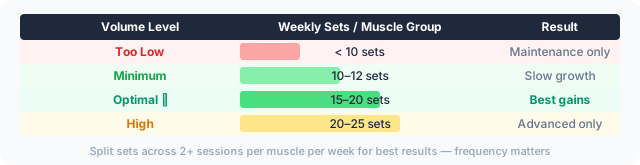
Volume is the primary driver of muscle hypertrophy. A landmark 2017 meta-analysis by Schoenfeld et al. found a clear dose-response relationship: more weekly sets per muscle group = more muscle growth, up to a recoverable threshold. The relationship held across beginners and intermediates alike.
The concept of volume landmarks — MEV, MAV, and MRV — comes from Dr. Mike Israetel's RP Strength research. MEV is the minimum you need to grow. MAV is where optimal growth happens. MRV is the ceiling above which recovery breaks down.
This calculator tracks your total sets per muscle group across all your logged exercises, then positions you within these landmarks so you can make informed programming decisions.
Volume landmarks by muscle group (sets/week)
| Muscle Group | MEV | MAV | MRV |
|---|---|---|---|
| Chest | 8 | 12–20 | 22+ |
| Back | 10 | 14–22 | 25+ |
| Shoulders | 8 | 16–22 | 26+ |
| Biceps | 8 | 14–20 | 26+ |
| Triceps | 8 | 14–18 | 22+ |
| Quads | 8 | 12–20 | 25+ |
| Hamstrings | 6 | 10–16 | 20+ |
| Calves | 8 | 12–16 | 20+ |
| Glutes | 4 | 10–16 | 20+ |
Progressive Overload: How to Increase Volume Over Time
Volume should increase gradually. Here's a sustainable 4-week progression model.
Frequently Asked Questions
How Many Sets Per Week for Maximum Muscle Growth?
The dose-response curve for volume and hypertrophy shows increasing returns up to roughly 20 hard sets per muscle group per week for most people. Beyond that, returns flatten and recovery becomes the limiting factor. For beginners, as few as 10 sets per week per muscle produces near-maximal hypertrophy — the nervous system adaptations early in training don't require high volumes. As you advance, your muscles adapt to the stimulus and need progressively more volume to keep growing.
The most important practical point: 16 sets per week in 2–3 sessions beats 16 sets per week in 1 session. Frequency is how you earn more productive volume.
Beginner vs Advanced Workout Volume — How Much Is Too Much?
Beginners can grow with 6–12 sets per muscle group per week and often see their best gains in the first 6–12 months with relatively low volume. The rapid gains come primarily from neural adaptations — the brain learns to recruit more motor units, not from dramatic muscle growth. Intermediate lifters (1–3 years) typically need 12–18 sets per week to keep progressing. Advanced trainees (3+ years) often need 16–22+ sets in periodised programs with planned deloads.
How to Track Weekly Training Volume for Progressive Overload
Keep a training log (notebook, app, or spreadsheet) with every set: exercise, reps, weight. At the end of each week, sum the sets per muscle group. Over a 4-week mesocycle, increase sets by 2 per week until you approach your MRV, then deload. Compare your tonnage (sets × reps × weight) from week 1 to week 4 — an increase in tonnage at the same RPE means you got stronger. This is the most reliable indicator that your volume is calibrated correctly.
Training Volume: The Most Underrated Variable in Muscle Building
Most gym-goers focus obsessively on which exercises to do and how heavy to go — but the biggest predictor of long-term hypertrophy is simpler: how many hard sets per muscle group do you do each week, consistently, over months and years?
Why Consistency Beats Intensity
A single brutal session doesn't build muscle — repeated, manageable stimuli do. Taking every set to absolute failure generates enormous amounts of muscle damage and metabolic stress, but the recovery demand is so high that frequency suffers. Training to 1–2 reps in reserve (RIR) and doing more sets per week consistently produces better long-term results than grinding to failure on fewer sets.
Note: Volume recommendations are general guidelines based on research populations. Individual recovery capacity, sleep quality, nutrition, stress levels, and training history all affect your personal MEV, MAV, and MRV. If in doubt, start at lower volumes and increase gradually.