🏋️ One Rep Max Calculator — Estimate Your 1RM for Any Lift
Enter the weight you lifted and the reps you completed. Get your estimated 1RM plus a full training percentage breakdown.
Formula Comparison
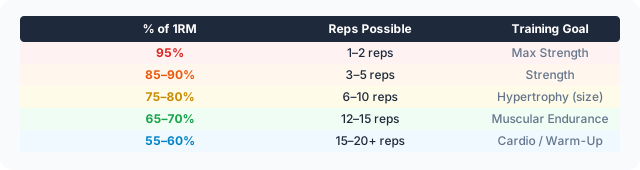
Training Percentage Table
| % of 1RM | Weight | Reps (approx) | Purpose |
|---|
Your saved lifts
Your strength level for this lift
Quick Strength Facts
Sources: NSCA, Epley (1985), Brzycki (1993)
How 1RM Formulas Work: Epley, Brzycki, and Lander Compared
One rep max formulas were developed by sports scientists to predict maximal strength from sub-maximal lifting. Instead of attempting a dangerous true 1RM every training session, you perform a heavy set at 3–10 reps and plug the weight and reps into a formula.
The three most validated formulas are Epley (1985), Brzycki (1993), and Lander (1985). Each uses a slightly different mathematical model. Epley uses an additive factor; Brzycki uses a ratio; Lander was specifically validated against actual 1RM tests in a lab setting.
All formulas become less accurate above 10 reps because fatigue and muscular endurance play larger roles. For the most reliable estimate, use a weight you can lift for 3–5 strict reps before failure.
The Three Formulas
1RM Strength Standards by Experience Level
1RM as a multiple of bodyweight. Based on aggregated data from competitive powerlifting and sports science research.
| Level | Bench Press (M) | Bench Press (F) | Squat (M) | Deadlift (M) |
|---|---|---|---|---|
| Untrained | < 0.75× | < 0.50× | < 1.0× | < 1.0× |
| Beginner | 1.0× | 0.65× | 1.25× | 1.5× |
| Intermediate | 1.25× | 0.85× | 1.5× | 2.0× |
| Advanced | 1.5× | 1.0× | 2.0× | 2.5× |
| Elite | 1.75×+ | 1.25×+ | 2.5×+ | 3.0×+ |
Values are approximate bodyweight multiples. Individual variation is significant.
Frequently Asked Questions
One Rep Max Calculator for Bench Press — How to Test Safely
The bench press is the most commonly tested 1RM lift. Before attempting a bench press max, ensure you have a qualified spotter or use a power rack with properly set safety pins. Warm up with at least 3 progressive sets before your working attempt. A good warm-up protocol: 50% × 10, 70% × 5, 85% × 2, 95% × 1, then your max attempt. For estimated 1RM, use a weight where you reach failure between rep 3 and rep 6. This calculator's Epley and Brzycki results will be within 3–5% of your true max at that rep range.
Grip width affects your bench press 1RM. A wider grip reduces range of motion and typically allows heavier weights but increases shoulder stress. Most strength standards are based on a grip approximately 1.5× shoulder width. Arch and leg drive are legal and widely used in powerlifting but reduce the effective range of motion — if you use them, your gym max may not translate directly to competition-style norms.
Squat and Deadlift 1RM Calculator — Powerlifting Standards
The squat and deadlift are the two highest-load lifts in most programs, meaning a true 1RM test carries more systemic fatigue and injury risk than the bench press. Estimated 1RM from a 3–5 rep set is especially valuable here. For the squat, depth matters — a 1RM achieved above parallel should not be compared to parallel or below-parallel standards. For the deadlift, conventional and sumo stances are biomechanically different enough that lifters often have significantly different 1RMs across the two variations.
Elite powerlifting totals (squat + bench + deadlift combined) typically exceed 6–8× bodyweight for men and 4–5× bodyweight for women. Using this calculator for all three lifts gives you a combined total you can track as your overall strength progresses.
How to Use 1RM Percentages for Programming Your Training
Once you have your 1RM estimate, the training percentage table this calculator generates tells you exactly what weight to load for every rep target. If your bench press 1RM is 100 kg, training at 75% means 75 kg — typically allowing about 10 clean reps. At 85%, you're at 85 kg for 5–6 reps. This predictable relationship lets you auto-regulate training load as your max strength improves.
Programs like 5/3/1 (Jim Wendler) use 90% of your true 1RM as a "training max" to build in buffer and reduce fatigue accumulation. If using such a program, enter 90% of your calculator result as your programming 1RM, not the full estimate. This approach produces consistent long-term progress without grinding close to failure every session.
One Rep Max Calculator: The Science Behind the Estimate
The concept of estimating maximal strength from submaximal efforts has roots in sports science going back to the 1970s. The Epley formula, published in 1985, became the most widely adopted because it was simple, usable without a calculator, and performed well across a range of lifters and exercises. Boyd Epley, the strength coach who developed it, needed a practical tool for programming hundreds of athletes without running 1RM tests constantly.
Why Different Formulas Give Different Results
The Epley, Brzycki, and Lander formulas make different assumptions about the rate at which rep performance drops off as load increases. At low reps (1–5), all three formulas converge and give similar results. At higher reps (8–15), the formulas diverge because the relationship between load and reps is not perfectly linear — it curves, and each formula models that curve differently. This is why using the average of all three formulas is the most conservative and often most accurate approach.
The Role of Fiber Type in 1RM Estimation
Lifters with a higher proportion of fast-twitch (Type II) muscle fibers tend to have higher true 1RMs relative to their rep performance at moderate loads. Conversely, lifters with more slow-twitch (Type I) fibers can sustain more reps at a given percentage of 1RM — meaning the formulas may slightly underestimate their true max. This individual variation is one reason no formula is universally accurate, and why using the average across multiple formulas reduces this error.
Note: This calculator provides estimates for training guidance purposes. True 1RM testing carries injury risk. Always prioritise form over weight, use appropriate safety equipment, and consult a certified strength coach if you are new to maximal effort lifting.