🏃 Running Pace Calculator — Pace, Speed & Finish Time
Calculate your pace from a finish time, estimate your finish time from a pace, or find out how far you'll run in a set time.
Race Finish Times at This Pace
| Distance | Finish Time | Speed |
|---|
Quick Running Facts
Sources: World Athletics, IAAF, running research literature
Running Pace vs Speed: What's the Difference?
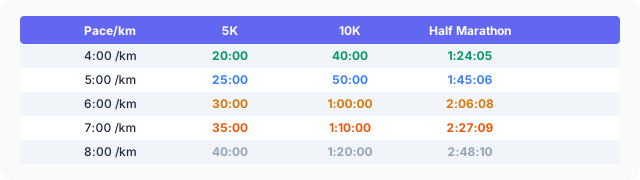
Running pace and speed express the same thing from opposite directions. Pace is time per unit distance (minutes per km or mile). Speed is distance per unit time (km/h or mph). Runners use pace because it directly answers "how long will this take?" — crucial when planning races and training sessions.
The core calculation is simple: if you run 10 km in 50 minutes, your pace is 50 ÷ 10 = 5:00 min/km. Your speed is 10 ÷ (50/60) = 12 km/h. To convert between the two: speed (km/h) = 60 ÷ pace (min/km).
This calculator handles three calculation types: given distance and time, it computes pace; given distance and pace, it computes finish time; given time and pace, it computes distance covered. All three are essential for race planning and workout tracking.
Common Race Paces
Training Paces: Easy, Tempo, Threshold, and Interval
Based on a 5K time of 25 minutes. Adjust proportionally for your pace.
Frequently Asked Questions
Running Pace Calculator for 5K — What Pace Do I Need?
The 5K is the most popular race distance in recreational running and a natural benchmark for progress. To run a sub-30-minute 5K, you need to average 5:59 min/km or faster. For sub-25, your average pace needs to be 4:59 min/km. For sub-20 — a significant milestone that puts you in the top 5–10% of recreational runners — you need to sustain 3:59 min/km for the entire distance.
A useful rule for 5K race day: the first kilometre should feel slightly too easy. Your goal pace should feel comfortable but focused around kilometres 2–3, and you should be pushing your limit in the final kilometre. If you're already at maximum effort in kilometre 1, you've gone out too fast. Use the 'Calculate Time' mode in this calculator to find out what finish time corresponds to your target pace before race day.
Marathon Pace Calculator — How to Set a Realistic Finish Time Goal
Setting a realistic marathon goal is one of the most important decisions a marathon runner makes. The most reliable predictor of marathon performance is your recent half marathon time. Multiply your half marathon time by 2.1 for a conservative estimate, or 2.05 if you have strong long-run training history. A runner who has run 1:45 for the half marathon can target approximately 3:39–3:41 for the full marathon.
The 'wall' — a dramatic slowdown typically occurring around kilometre 30–35 — is caused by glycogen depletion. Runners who start at their true capability pace almost always hit the wall; those who start 5–10 seconds per km conservative and build through the second half typically do not. This calculator lets you plan kilometer splits in advance so you can race with precision rather than guesswork.
Easy Run Pace vs Tempo Pace — What's the Right Training Pace?
One of the most common training mistakes is running easy days too fast and therefore not recovering adequately for hard days. Your easy pace should feel genuinely easy — you can hold a full conversation, your breathing is relaxed, and you feel like you could continue for hours. For many runners, this means slowing down by 90 seconds to 2 minutes per km compared to their race pace.
Tempo pace, by contrast, should feel 'comfortably hard' — you can speak a sentence but not a paragraph. It sits at the lactate threshold, which is the training intensity that most directly improves race performance. Typical tempo sessions are 20–40 minutes sustained or broken into shorter tempo intervals with brief recovery. Enter your target race pace into this calculator and use the speed output to calibrate your training zones accordingly.
Running Pace Calculator: The Mathematics of Racing
The relationship between pace, distance, and time is the fundamental equation of endurance running. Every training decision — how fast to run, how far to go, whether a workout was appropriately challenging — ultimately comes back to this triangle. Understanding it deeply is what separates runners who progress systematically from those who plateau.
Why GPS Devices Still Need Pace Calculators
GPS running watches are accurate under open sky but exhibit significant drift in tunnels, dense urban canyons, and forests. Over a marathon, GPS drift can add or subtract 200–400 metres, making the displayed pace unreliable in these environments. Knowing how to calculate your own pace from manual splits — using a stopwatch and known distance markers — remains a valuable skill for race day. This calculator can reverse-engineer any split: enter the distance of a lap and your split time to find your exact pace for that segment.
Note: Running calculators assume even effort across the distance. Real-world performance is affected by terrain, temperature, hills, fatigue accumulation, and fuelling. Use calculator results as targets and starting points, adjusting in real time during training and racing.