⚖️ Ideal Weight Calculator — Healthy Weight Range for Your Height
Find your ideal body weight using four clinical formulas — Robinson, Devine, Miller, and Hamwi — with frame size adjustment.
Your ideal weight estimates:
Ideal Weight Facts
How Ideal Weight Formulas Were Developed
Ideal body weight formulas were originally developed not for fitness goals but for clinical use — calculating drug dosages, ventilator settings, and nutritional support in hospitalised patients. The Hamwi formula (1964) appeared first, followed by Devine (1974), then Robinson and Miller both published refinements in 1983.
Each formula uses a linear equation based on height: a base weight for 5 feet (152.4cm) with an increment per inch of height above that. They differ slightly in their base values and per-inch increments, which is why they produce different results for the same person.
None of the formulas account for muscle mass, body composition, or ethnicity — factors that meaningfully affect what a healthy weight looks like for a specific individual.
The four formulas (for 170cm / 5'7" height)
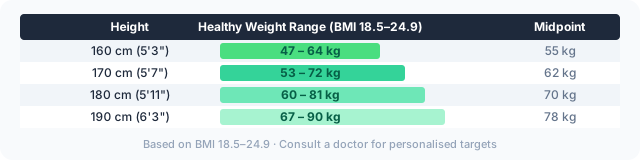
Ideal Weight by Height — Quick Reference
Average of Robinson, Devine, Miller & Hamwi formulas. Medium frame. Values in kg.
| Height | Male (avg) | Female (avg) | BMI 18.5–24.9 range |
|---|---|---|---|
| 155cm (5'1") | 55–57 kg | 51–53 kg | 44–60 kg |
| 160cm (5'3") | 59–61 kg | 55–57 kg | 47–64 kg |
| 165cm (5'5") | 63–66 kg | 58–61 kg | 50–68 kg |
| 170cm (5'7") | 67–70 kg | 62–65 kg | 53–72 kg |
| 175cm (5'9") | 71–74 kg | 66–69 kg | 57–76 kg |
| 180cm (5'11") | 75–79 kg | 70–73 kg | 60–81 kg |
| 185cm (6'1") | 80–83 kg | 74–78 kg | 63–85 kg |
Frequently Asked Questions
Ideal Weight for Women by Height — Which Formula Is Best?
For women, the Robinson formula is generally considered the best-calibrated of the four. It was specifically developed as a refinement of Devine with updated population samples. The Devine formula (which was derived from data on men and simply adjusted for women) tends to produce slightly lower values. For practical purposes, average the four formulas and add ±10% for your frame size — the resulting range gives a realistic target without over-specifying a single number.
Ideal Body Weight Calculator for Men — Military and Clinical Standards
The US military uses a weight-for-height table with maximum weight limits and a body fat standard as the fallback. A man who exceeds the maximum weight table but passes the body fat tape test is still eligible — this recognises that muscular individuals legitimately exceed IBW predictions. The Army's standards roughly correspond to BMI 27.5 for men, which is above the standard "overweight" threshold but reflects the reality of physically fit, muscular soldiers.
How Frame Size Affects Your Ideal Weight
Frame size is rarely discussed but meaningfully changes your target range. Bone density and skeletal dimensions contribute significantly to total body weight — a large-framed person with healthy body composition simply weighs more than a small-framed person at the same height and fitness level. The ±10% adjustment for frame size translates to roughly 6–8kg for most adults. If you're naturally broad-shouldered with dense bones, a weight at the upper end of your IBW range is perfectly appropriate.
Ideal Weight: What the Formulas Don't Tell You
The four IBW formulas were all developed before the widespread use of DEXA scans and body composition analysis. They assume a linear relationship between height and ideal weight that holds reasonably well for the average population but breaks down for athletes, people with unusual proportions, or those of non-European ancestry (for whom BMI cutoffs themselves are debated).
The Practical Limitation
These formulas produce a single point estimate that gives a false sense of precision. A 175cm man is told his IBW is 72kg — but a muscular 80kg man with 12% body fat and a lean 65kg man with 22% body fat are on opposite ends of the health spectrum despite both sitting near the IBW range. Use IBW as one data point alongside body fat percentage, waist circumference, and fitness markers.
Note: Ideal weight is a reference tool, not a medical target. Speak with a healthcare provider or registered dietitian if you have specific health conditions or concerns about your weight. Body composition, metabolic health, and fitness level matter far more than any single number.