❤️ Heart Rate Calculator — Training Zones for Fat Burn & Cardio
Enter your age and optional resting heart rate to find your max HR and all five training zones.
| Zone | Name | % Max HR | BPM Range | Purpose |
|---|
Estimated VO₂max (from resting HR)
Formula: Uth et al. (2004) — 15 × (maxHR ÷ restingHR)
How to measure your resting heart rate accurately
- Stay lying still in bed for at least 5 minutes after waking — before coffee, phone, or getting up
- Find your pulse at your wrist (radial artery, below the thumb) or lightly on your neck
- Count beats for 60 seconds — or count for 30 seconds and multiply by 2
- Repeat on 3 consecutive mornings and use the average
- Avoid alcohol the night before and caffeine before measuring
Quick Heart Rate Facts
Sources: AHA, Fox & Haskell (1970), Tanaka et al. (2001)
How Heart Rate Zones Work: The Science of Training Intensity
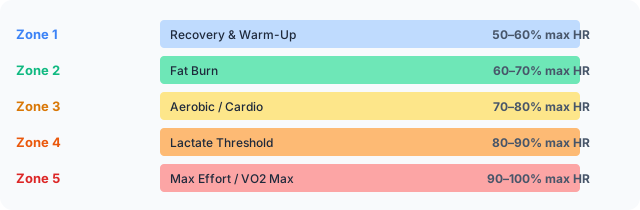
Heart rate zones divide your intensity spectrum into meaningful bands, each with distinct physiological effects. Training in the right zone for the right purpose is one of the most evidence-backed principles in endurance sports and cardiovascular fitness.
At low intensities, your body primarily burns fat for fuel. As intensity increases, it shifts toward carbohydrates, which can be metabolised faster to meet higher energy demands. At maximum intensity, the anaerobic system takes over entirely.
The Karvonen formula, introduced in 1957, was a significant improvement over simple percentage-of-max methods because it uses your heart rate reserve — the functional range between your resting and max HR — as the basis for zone calculation. This personalises zones to your actual cardiovascular fitness level.
The 5 Heart Rate Training Zones
Resting Heart Rate Chart by Age — What's Normal?
Measure first thing in the morning, before getting out of bed, for the most accurate resting HR.
| Age | Athlete | Excellent | Good | Average | Poor |
|---|---|---|---|---|---|
| 18–25 | 49–55 | 56–61 | 62–65 | 66–69 | 70+ |
| 26–35 | 49–54 | 55–61 | 62–65 | 66–70 | 71+ |
| 36–45 | 50–56 | 57–62 | 63–66 | 67–70 | 71+ |
| 46–55 | 50–57 | 58–63 | 64–67 | 68–71 | 72+ |
| 56–65 | 51–56 | 57–61 | 62–67 | 68–71 | 72+ |
| 65+ | 50–55 | 56–61 | 62–65 | 66–69 | 70+ |
Values in bpm. Source: American Heart Association / Cooper Institute norms.
Frequently Asked Questions
Heart Rate Zones for Fat Burning — Is the 'Fat Burn Zone' Real?
The 'fat burning zone' (Zone 2, 60–70% max HR) is frequently misunderstood. At this intensity, your body does use fat as its primary fuel source — roughly 60–65% of calories burned come from fat oxidation. However, the total calorie burn per minute is much lower than at higher intensities. This creates a paradox: you burn a higher proportion of fat at low intensity, but more total fat in the same time period at moderate-to-high intensity.
Where Zone 2 training truly shines is in developing your aerobic base — the underlying cardiovascular machinery that determines how efficiently you can use fat as fuel at all intensities. Elite endurance athletes spend enormous volumes of training in Zone 2 specifically to develop this metabolic foundation. For the average gym-goer with limited time, higher-intensity training and overall calorie deficit are more important for fat loss than staying in Zone 2.
HIIT Heart Rate Calculator — How High Should Your Heart Rate Go?
HIIT (High-Intensity Interval Training) is most effective when work intervals push heart rate into Zone 4–5 (80–100% max HR). A common HIIT protocol is 20–40 seconds of all-out effort followed by 40–80 seconds of rest or light activity, repeated 6–10 times. During the work intervals, heart rate should climb to 85–95% of maximum. Because of the intensity, HIIT sessions are typically 20–30 minutes total.
Research consistently shows that HIIT produces similar or greater cardiovascular fitness improvements as longer moderate-intensity sessions in less time. It also produces a significant EPOC (excess post-exercise oxygen consumption) effect — your metabolism stays elevated for hours after the session, contributing additional calorie burn. However, HIIT should be limited to 2–3 sessions per week due to the high recovery demand.
Resting Heart Rate Chart by Age — What's Normal?
Resting heart rate naturally changes with age and fitness. In adolescence, resting HR tends to be slightly higher; it stabilises through adulthood and may rise slightly in later decades as cardiovascular efficiency declines. Regular aerobic exercise is the most powerful lifestyle intervention for lowering resting heart rate — even moderate amounts of cardio can reduce resting HR by 5–10 bpm over several months.
Tracking your resting heart rate over time is a free and underutilised fitness metric. As your cardiovascular fitness improves, your resting HR should trend downward. A sudden unexplained elevation in resting HR can indicate overtraining, illness, stress, or poor sleep, making it a useful daily biometric for athletes to monitor.
Heart Rate Calculator: The Physiology Behind the Zones
Heart rate training zones have been used in serious endurance coaching since the 1970s. The foundational research by Fox and Haskell (1971) established the 220-minus-age formula as a population-level maximum heart rate estimate, and subsequent decades of sports science built a training zone framework on top of it.
Why the 220 − Age Formula Is Only an Estimate
The 220 − age formula is a linear approximation of a non-linear biological reality. It was never intended to be used for individuals — it describes a population average with a standard deviation of ±10–12 bpm. This means two people of the same age can have maximum heart rates 20–25 bpm apart and both be completely normal. The Tanaka formula (208 − 0.7 × age) was derived from a meta-analysis of 351 studies and is more accurate, especially for older adults, where the classic formula tends to overestimate max HR.
Heart Rate and Medications
Beta-blockers — commonly prescribed for hypertension and heart conditions — directly lower heart rate at rest and during exercise. If you take beta-blockers, the age-based maximum heart rate formulas will significantly overestimate your actual max HR, making zone calculations unreliable. Work with your physician to establish appropriate exercise intensity targets if you are on cardiac medications.
Medical Note: Heart rate zone training is intended for healthy adults. If you have heart disease, hypertension, or known cardiac arrhythmias, consult your physician before beginning exercise at elevated heart rate zones.